By Jackie Ndebu (Chair Conference planning 2025)

1. Introduction: The Power of Confidence
Confidence is one of the most transformative forces in leadership. I once spoke to a
colleague who practiced positive self-talk two or three times a day. Within a week, her
husband noticed the change — she carried herself differently, shoulders back, walking tall.
When she later attended an interview and was asked, “What kind of leadership skills do you
have?”, she used the acronym of her own name to describe her strengths — beginning with
“P is for…” and ending with her full name, Philomena. The panel was deeply impressed, and
she secured a Very Senior Management (VSM) position at Integrated Care Board (ICB) level
— not just a Band 9 role.
That story reminds us: when confidence grows, opportunities follow. But anxiety and stress
can rob us of that confidence. To rebuild it, we must practice positive self-talk, movement,
and mindfulness. Sometimes, it is as simple as putting on music and dancing — letting your
body move, raising serotonin, oxytocin, and dopamine levels — those “feel-good” hormones
that reset our mindset.
2. Reconnecting with Nature and Self
Nature has a remarkable ability to heal. Personally, I try to take a walk in the park three
times a week — on Mondays, Wednesdays, and Fridays. Gym memberships can be costly,
but nature is free. Fresh air, sunlight, and movement lift serotonin levels and calm the mind.
Take a moment to notice the beauty around you — the colour of the leaves, the sky, the
stillness of water. These moments of mindfulness help us reconnect with gratitude and
peace.
3. The Importance of Reflection and Journaling
Another powerful tool is journaling. Writing helps to declutter the mind and process
emotions. When someone behaves poorly towards you at work, write it down. Record what
was said, how it made you feel, and why you think it affected you.
When I used to share my reflections with my sister — a barrister — she would often say,
“Jo, there’s too much emotion here. Strip it down to the facts.” She was right. Emotion is
valid, but clarity is power. Write everything first to release it, then refine it into a few clear
sentences that identify the issue objectively.
When communicating professionally — especially in difficult circumstances — keep your
message short, factual, and assertive. Managers and HR departments are more responsive
to clear evidence than emotional accounts.
4. Advocacy, Mentorship, and Professional Courage
Sometimes, we face unfair treatment. A staff member once told me her manager repeatedly
blocked her from attending a training course. I advised her to write an email stating,
“Following our one-to-one, you informed me that I could not attend this course. However,
according to the study leave policy, I meet the criteria, and others have attended similar
courses. Could you clarify why I am not eligible?” — and to copy the line manager’s manager
into the message.
Within days, the decision was overturned, and she was approved for the course.
This highlights the importance of knowing your rights, documenting your interactions, and
finding a mentor or coach to guide you. Mentorship brings perspective, confidence, and
professional protection.
Another nurse I supported had worked in the NHS since 2004. She was told she could not
apply for senior positions or receive training for ten years. For more than a decade, she
remained a Band 5. Yet, by 2017, she had earned a Master’s degree, became a Nurse
Prescriber, and completed the Advanced Nurse Practitioner programme — but was still
Band 6.
I encouraged her to job-match: compare her duties with a Band 7 job description and
present the evidence. When HR reviewed her case, they agreed she should indeed be Band
7. Despite managerial resistance — and multiple errors on purpose in her change forms —
persistence paid off. Eventually, her re-banding was approved, proving that self-advocacy
and evidence-based communication can break barriers.
5. Managing Workplace Anxiety and Stress
Many of us experience anxiety at work. Sometimes it stems from workload, but often it’s
caused by difficult interpersonal dynamics. – Take time away when needed. – Focus on one task at a time — multitasking creates cognitive overload. – Keep your phone out of sight when working. – Prioritise sleep and rest.
If anxiety becomes overwhelming, access your organisation’s Employee Assistance
Programme (EAP) — many offer six free counselling sessions. These services are
underused, yet invaluable for emotional wellbeing.
During your lunch break, step outside. Do not feel pressured to conform to a culture where
everyone eats at their desk. Go for a walk, sit on a bench, breathe, and return refreshed. Self
care is not selfish — it is essential.
6. Coping with Anxiety: Practical Tips
When anxiety surfaces: – Identify the trigger — what or who is causing the tension? – Pause and breathe — give your body permission to slow down. – Focus on what you can control, not what you can’t. – Complete one task before starting another.
Even at home, break large chores into smaller parts. Finishing one task restores a sense of
progress and control, reducing stress.
7. Grief, Loss, and Emotional Healing
Sometimes, what we label as stress or anxiety is actually grief — the loss of hope,
opportunity, or connection. Many of us experience grief after migrating to a new country,
being separated from family, or feeling undervalued at work.
The emotional, spiritual, physical, and behavioural symptoms of grief mirror those of
anxiety: – Emotionally: anger, guilt, emptiness, despair. – Spiritually: loss of faith, questioning purpose, anger toward life or God. – Physically: headaches, sleeplessness, stomach pain, fatigue. – Behaviourally: overuse of screens or social media, withdrawing from others.
Recognising grief for what it is allows healing to begin. We must acknowledge our pain, seek
support, and give ourselves permission to recover.
8. Closing Message
In conclusion, leadership begins with self-awareness. Confidence, resilience, and self
compassion are not optional — they are survival tools.
Stand tall, speak clearly, document your truth, and never stop believing in your value.
Surround yourself with mentors and allies who lift you up, and take time to care for your
mind and spirit.
Because when you lead yourself with confidence and integrity, you empower others to do
the same.
Thank you.
Some photos of the day…
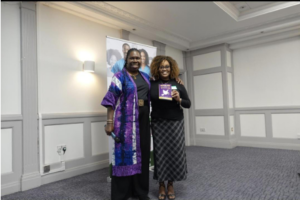
Dr Myers with Leah Wahinya (one of the KENMA-UK member)
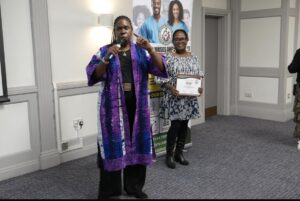
Dr Myers presenting a Certificate of appreciation to Dorcas Mwisya (one of the
KENMA-UK Member)
Dr Myes with the High Commission Kenya- UK Ambassador Catherine Karemu

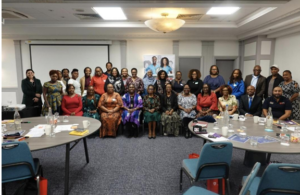
Group Photos during the KENMA-UK Conference: